
British Prime Minister David Cameron recently asked Prime Minister Narendra Modi's help to send back six British sailors who have been in Tamil Nadu for two years.

'In contrast to the generally buoyant tone of the Economic Survey in January, he sounds uncharacteristically pessimistic, saying that forces in the world economy -- slowing global trade, protectionism, robots -- will limit India's manufacturing to levels well below what propelled East Asia's economies decades ago.'

Indian economy is expected to improve marginally in the current financial year with its GDP at market price projected to expand by 3.4 per cent from 3.3 per cent in the previous fiscal, think tank OECD said.

Government allows duty-free import of 500,000 tonnes raw sugar till June 12. At present, India levies an import duty of 40% on sugar

The latest forecast, given by Earth Sciences Minister Jitendra Singh, was a downward revision from a previous forecast of 93 per cent given at the outset of the monsoon in June, but was nowhere near as bad some farmers had feared.
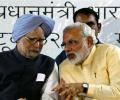
NDA under Mr Modi is as focused on the rural poor with doles and hand-outs as the UPA under Dr Singh was.

Panagariya has advocated a more liberalised spending, arguing that greater capital expenditure could relax some of the infrastructure bottlenecks facing the country.

Over to the government how they manage the uncertainty of monsoon and revive spending in order to entice RBI for another round of rate cuts

'When you come through the hassles and struggles of business life, your mind is wired differently.' 'You are more connected to reality,' Akali Dal MP Naresh Gujral tells Rahul Jacob and Archis Mohan

Pranjul Bhandari, Chief India Economist, HSBC, speaks about a range of issues ranging from inflation, to how Goods and Services Tax and land acquisition bills can help India hit double digit growth, and her impressions about economic growth in the last one year after Narendra Modi took over as India's Prime Minister.

The negative aspect about the Budget is that the capital expenditure has been marginally cut to achieve the fiscal deficit target assumptions, and the onus of sustaining investment demand till private capex revives continues to vest with the public sector enterprises, notes Jyotivardhan Jaipuria.

The total rainfall till now is not only deficient, but is also erratic in terms of both geographical spread and timings.

The country has produced a record harvest, but many farmers in the onion bowl of Maharashtra have lost a large share of their crop damaged in storage, adding to the country's inflation woes.
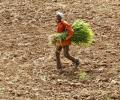
In spite of Budget's rural focus, the government has consistently stumbled in agriculture, says Shreekant Sambrani.

Gujarat has around 3,000 licensees for allopathic drug manufacturing, apart from around seven homeopathic licensees, 500 ayuvedic and 600-700 cosmetics licensees
As many as 75 million households that do not have access to banking services will be covered and at least one bank account opened for each household, against the earlier proposal of two.

Curbing the federal deficit is the government's absolute priority on February 28.

From Dabur to HUL, here are 10 stocks with significant rural exposure in the auto, agri-chemical and fast moving consumer goods sectors, which should see an uptick in sales growth.
Ahead of the Economic Survey, industry body Ficci today lowered its GDP growth forecast for the current fiscal, pegging India's economic expansion rate at 5.3 per cent compared to its 5.5 per cent previous estimate.

The 30-share Sensex gained 321 points to end at 26,430 and the 50-share Nifty surged 100 points to end at 7,879.

While his father has often been quoted on tips for investing, Buffett junior's focus is on spreading the word about both self-improvement and ways in which to make a positive difference in the world - with a special focus on solving hunger.

Signs of a strong pickup in hiring by companies are adding to the rosier outlook for Indian households.

Former chairman of the UIDAI Nandan Nilekani, elucidates how Aadhaar could become the spine for alternative banking and could replace government services with cash benefits.

Here's the full text of President Ram Nath Kovind's address to the nation on the eve of 71st Republic Day.
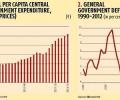
One may fault this government for incompetence, corruption, and delayed action but it cannot be faulted for lacking a vision.
It was widely expected that this time around, the government would be less likely to initiate fresh reforms and rather loosen its belt a little to give various segments of the economy, especially the multitudes that truly constitute India, something to smile about, says Sudip Bandyopadhyay.
Experts say it will now be tough for the Modi government to catch up with the UPA's economic record owing to the shock induced by the currency demonetisation.

As fuel prices surged in September, the government's decision to ask companies to cut price by Rs1 each on a litre of petrol and diesel came as a dampner for private players.

Loan waivers will never be enough. Reforming the agricultural marketing system is essential to addressing the concerns of farmers in a sustainable manner, says Nitin Desai.
Three policymakers aware of the central bank's deliberations on the Budget said they are combing through the numbers to test how Jaitley struck a balance, and question some of the assumptions.

In 2012-13, the Centre managed to cut fiscal deficit to 4.9% of GDP, lower than the Budget revised estimates of 5.2%
.jpg)
The catalyst is the run on emerging market equities, but many investors are just tired of waiting for India to get its act together.
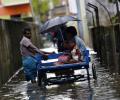
Some of the World Bank's suggestions to hold back the predicted tide of fresh poverty appear to run counter to the economic policies of Narendra Modi's government

Most expect the Budget to be path-breaking.

The government's initial promise and energy seems to have dissipated.

In less than two months since the announcement in March, the state has mobilised an armada of small and medium enterprises keen on making components for large equipment manufacturers.
FIXES BY THE GOVERNMENT: Energy price fixed, tax issues linger.

Worried about the adverse impact that price rise could cause to Congress' prospects in Lok Sabha polls, Rahul Gandhi unveiled quick fix policy prescriptions for 12 party-ruled states including reform in PDS and giving farmers a wider choice to sell vegetables and fruits.

Technically speaking, US equities have seen net losses since January. India is strongly influenced by US trends.

High fiscal deficits raise inflation which hits the lowest income and salaried classes.
